Preparation method and bacterial composition are the major differences between yogurt and curd. Yoghurt requires a specific bacterial composition and a controlled environment, whereas curd can be easily made at home by adding lemon juice, vinegar, or existing curd to warm milk.
Difference Between Yogurt and Curd: What Actually Matters When Choosing Between Them

While both are fermented dairy products made from milk, the difference between yogurt and curd is how they are prepared, the bacterial strains used, their texture, consistency, and taste. Curd is easily made at home by adding lemon juice, vinegar, or existing curd to warm milk. Yogurt requires controlled conditions and specific bacterial cultures, such as Lactobacillus bulgaricus and Streptococcus thermophilus.
While choosing between them, it is important to consider whether you’re lactose-sensitive, following diets, or trying to lose weight. Check the labels and nutritional value before consumption to make informed dietary choices. Follow the article to know more about the difference between yogurt and curd, their nutritional value, FSSAI recommendations, and more.
Quick Answer:
The basic difference between yogurt and curd is how they are processed and their bacterial composition.
Curd is made at home by adding an acidic substance, like lemon juice, vinegar, or existing curd, to warm milk. It has a lumpy and gelatinous texture with a mildly tangy taste.
Yogurt requires commercially controlled conditions and a specific starter culture, Lactobacillus bulgaricus and Streptococcus thermophilus. It has a thick and creamy texture with a more tart taste.
Table of Contents:
- Are Yogurt and Curd The Same?
- Yoghurt vs Curd: Difference Between Curd and Yogurt
- What Does FSSAI Say About Curd Vs Yogurt
- Curd Vs Yogurt Nutritional Value
- Greek Yogurt Vs Curd: Understanding the Difference Between Both
- Yogurt and Curd: Which Is Better?
- Can We Use Curd Instead of Yogurt?
- Bottom Line
- Frequently Asked Questions (FAQs)
Are Yogurt and Curd The Same?
If you’re wondering if yogurt and curd are the same, then the answer is no; they differ in terms of their preparation, processing, bacterial composition, texture and taste, nutritional value, and more. Although both are dairy products made with fermented milk, their starter cultures and preparation are distinct.
Here are major differences between yogurt and curd:
- Starter Culture
- Curd: An acidic substance (lemon juice or vinegar) or a small amount of existing curd to ferment milk.
- Yogurt: Commercial bacterial cultures, including Lactobacillus bulgaricus and Streptococcus thermophilus.
- Preparation Method:
- Curd: Add lemon juice, vinegar, or existing curd to warm milk and allow it to ferment. Generally prepared at home.
- Yogurt: Commercial fermentation; requires a specific starter culture and controlled conditions.
- Texture and Taste
- Curd: Lumpy texture, mildly tangy taste.
- Yogurt: Thick and creamy, tangy and tart taste.
- Culinary Uses:
- Curd: Used to make raita, lassi, kadhi, and marinades in Indian households.
- Yogurt: Primarily used as a dip, salad dressing, and marinade.
Yoghurt vs Curd: Difference Between Curd and Yogurt
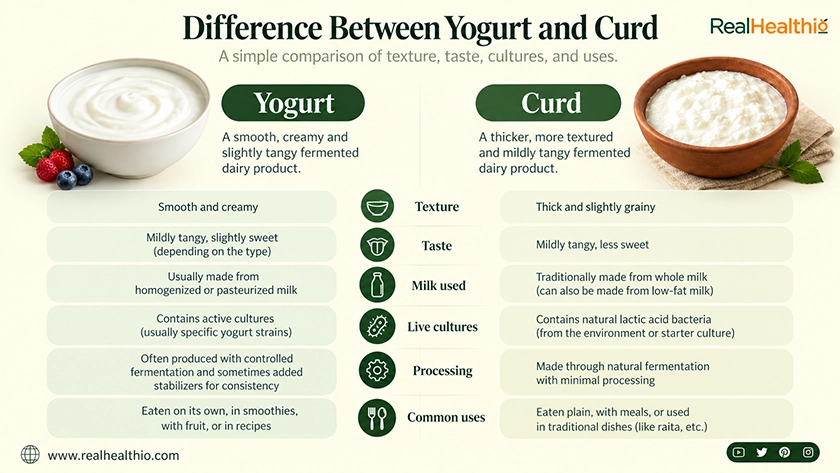
Preparation method, nutritional profile, and bacterial strains used are the major differences between dahi and yogurt.
Curd is made by adding an acidic substance (vinegar or lemon juice) or a spoonful of a previous batch of curd to warm milk; on the other hand, yoghurt is commercially prepared under controlled conditions with specific bacterial cultures.
Here are the major differences: yogurt vs curd
| S No. | Points of Difference | Curd | Yogurt |
|---|---|---|---|
| 1. | Preparation Method | Made at home by adding either:
| Prepared commercially using:
|
| 2. | Bacterial Composition | Made with Lactobacillus acidophilus. However, composition varies. | Specific thermophilic cultures are used, including:
|
| 3. | Texture and Consistency | Soft, lumpy, and cuttable texture. Gelatinous texture. | Smooth, creamy, and thick texture |
| 4. | Taste | Mildly tangy | Acidic taste, distinctively tangy |
| 5. | Nutritional Value |
|
|
| 6. | Culinary Uses | Used to make raita, kadhi, lassi, and marinades in Indian households. | Used as a dip, added to smoothies, acai bowls, or eaten with granola and cereals. |
| 7. | Shelf Life | Shorter, especially for home-made curd. | Longer due to controlled commercial production and packaging. |
| 8. | Lactose | Higher lactose than yogurt. NOT suitable for lactose-intolerant individuals. | Lower lactose, suitable for lactose-intolerant people. |
| 9. | Probiotic Content | No mandatory CFU count. | Prescribed by ECFR.Gov, yoghurt may contain live and active cultures (LAC) at 107 colony-forming units (CFU). |
What Does FSSAI Say About Curd Vs Yogurt
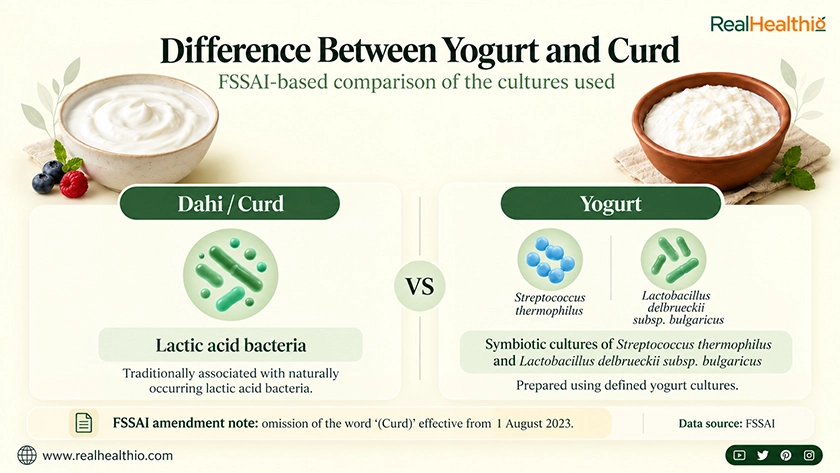
According to the Food Safety and Standards Authority of India, curd (dahi) and yogurt are defined as:
- Curd (Dahi): “means the product obtained from pasteurised or boiled milk by souring, natural or otherwise, by a harmless lactic acid culture or other harmless bacterial culture”.
- Yogurt: “a coagulated product obtained from pasteurised or boiled milk or concentrated milk by lactic acid fermentation through the action of Lactobacillus bulgaricus and Streptococcus thermophilus”.
The 2023 Label Change Amendment:
In January 2023, FSSAI amended its fermented-milk standard and removed the word “curd.”
However, as brands and consumers pushed back, it clarified on March 30, 2023, that the word “curd” should be used alongside regional names, such as curd (dahi), curd (thayir), etc.
To identify yogurt, check the label for:
- Names L. bulgaricus and S. thermophilus (bacterial cultures)
- Thermised or heat-treated yoghurt (if heated after setting at 65 degrees)
Whereas, for curd (dahi), the label would rather state,
- “Lactic cultures”
As per CODEX STANDARD FOR FERMENTED MILKS, the standard live and active bacteria must be alive till the best-before date. The limit is 10⁷ CFU per gram.
BIS Standards
| BIS Standards | ||
|---|---|---|
| BIS Standards | Curd | Yogurt |
| BIS Standard Number | IS 9617:2023 | IS 12898:2022 |
| Official Title | Dahi – Specification (First Revision) | Dairy Products – Yoghurt- Specifications (First Revision) |
| Product Classification | Dahi, subject to the applicable standards’ requirements. | Includes plain, skimmed, low-fat/partly skimmed, sweetened, flavoured, and fruit yogurt. |
| Microbiological Requirements | Includes:
| Specific characteristics of:
|
Dahi Vs Yogurt
These terms are often used loosely in India, so here is how they are commonly used:
| Term | Hindi | Meaning | Common uses |
|---|---|---|---|
| Curd / Dahi | दही | Fermented milk set with lactic acid bacteria. In India, curd commonly means dahi. | Daily meals, raita, kadhi, and curd rice |
| Yogurt / Yoghurt | योगर्ट | Fermented milk made with specified starter cultures under the applicable product standard. | Packaged tubs, smoothies, dips, and desserts |
| Greek yogurt | ग्रीक योगर्ट | Strained or concentrated yogurt with a thicker texture. Protein content varies. | Snacks, dips, and bowls |
| Hung curd | चक्का* | Dahi drained to remove whey and make it thicker. | Dips, sandwiches, and shrikhand base |
| Chaas | छाछ | An Indian drink commonly made by diluting or churning dahi. | Summer drink and meal accompaniment |
| Lassi | लस्सी | A blended curd-based drink that may be sweet or salted. | Beverage |
*Indian chaas is not necessarily the same as cultured buttermilk sold in some Western countries, although both may be called buttermilk in English.
Curd Vs Yogurt Nutritional Value
The following nutritional values of yoghurt and curd have been taken from the US Department of Agriculture, USDA’s FoodData Central Food Research:
Here’s a list of curd vs yogurt nutrition:
| Nutrients | Curd Nutritional Value (per 100 grams) | Yoghurt Nutritional Value (per 100 grams) |
|---|---|---|
| Calories | 103-105 kcal | 59-61 kcal |
| Carbohydrates | 4.6 g | 3.64 g |
| Protein | 3-4 g | 10.3 g |
| Fats | 3-4 g | 0.17-0.37 g |
| Calcium | 88 mg | 111 mg |
*The nutritional value varies by product. For example, regular yogurt may have slightly more calories than Greek yogurt. Check the packaging for accurate nutritional value.
Also Read: Calories in 1 Roti: Understanding the Nutrition in Everyday Indian Food
Greek Yogurt Vs Curd: Understanding the Difference Between Both
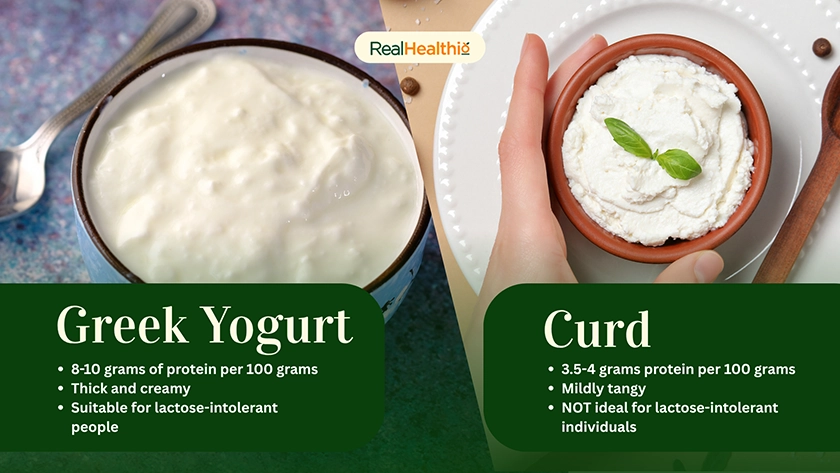
The difference between Greek yogurt and curd is that Greek yoghurt is commercially prepared by removing its whey through heavy straining, giving it a thicker and creamier texture with high protein content. Curd, on the other hand, can be easily prepared at home using acidic substances and milk.
Here’s the difference: Greek yogurt vs curd:
| S No. | Points of Difference | Greek Yogurt | Curd |
|---|---|---|---|
| 1. | Preparation | Greek yoghurt is prepared by:
| Curd’s preparation includes either:
|
| 2. | Protein Content | High, compared to curd and yogurt, 8-10 grams of protein per 100 grams. | Low, compared to Greek yogurt, 3.5-4 grams per 100 grams. |
| 3. | Texture and Taste | Thick, creamy, and comparatively tangier and tart than regular yoghurt. | Mildly tangy |
| 4. | Lactose | Lower; suitable for lactose-intolerant people | Higher, NOT ideal for lactose-intolerant individuals. |
| 5. | Culinary Uses | Used as salad dressing, cream cheese, marinades, mayonnaise, and more. | Used to make raita, kadhi, lassi, and marinades. |
| 6. | Carbohydrates | Low, 3-4 grams per 100 grams | Moderate, 4-5 grams per 100 grams. |
| 7. | Ideal For | Keto diets and weight management. | Everyday use |
| 8. | Cost | Generally expensive and premium | Affordable; could be made at home easily. |
Hung Curd Vs Greek Yogurt
While both hung curd and Greek yogurt are made by straining whey from fermented dairy, the main differences lie in their bacterial composition, preparation, and processing.
Here are the major differences between hung curd and Greek yogurt:
| S No. | Points of Difference | Hung Curd | Greek Yogurt |
|---|---|---|---|
| 1. | Preparation | Hung Curd is prepared by:
| Preparing Greek yoghurt requires:
|
| 2. | Bacterial Composition | Use of variable lactic acid bacteria (LAB). | Specific bacterial cultures: Lactobacillus bulgaricus and Streptococcus thermophilus |
| 3. | Texture and Taste | Mildly thick and creamy, solid/cuttable texture. Mildly savoury and tangy. | Very thick, creamy, and comparatively tangier and tart than regular yogurt and hung curd. |
| 4. | Lactose | Lower, compared to regular curd. Suitable for people with mild lactose intolerance. | Highly suitable for lactose-intolerant individuals. |
| 5. | Shelf Life | 3-5 days; must be kept in an airtight container in the refrigerator. | Must be consumed within 5-7 days and should be kept in the refrigerator. |
Important Note: Spoilage Signs and Best Practices
Hung Curd:
- Consume within 2 days for best flavour and texture.
- Avoid consuming it if it has a strong, unpleasant, vinegar-like odor.
- Do NOT freeze hung curd.
Greek Yoghurt:
- Avoid keeping at room temperature for more than 3-4 hours.
- Do NOT consume if there are fuzzy spots, unusual color changes, or a vinegar-like smell.
Yogurt and Curd: Which Is Better?
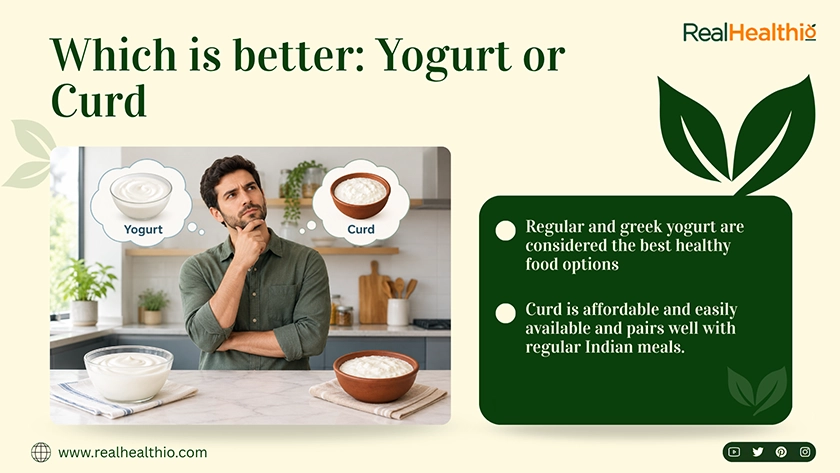
Generally, regular and Greek yogurt are considered the best healthy food options because they are low in calories and lactose, high in protein and probiotic content, and have live and active cultures, essential for digestive health. However, curd is easily available, can be made at home, and is affordable, which makes it an ideal part of an everyday routine.
The right choice, however, depends on what you’re looking for: lactose sensitivity, weight loss, gut health, or an everyday Indian diet.
If you’re confused between yogurt and curd which is better, follow to learn about both:
| Goal | Which is Better: Yogurt or Curd? |
|---|---|
| Lactose Sensitivity | Yogurt
|
| Weight Loss | Regular and Greek Yogurt
|
| Gut Health | Both Curd and Yogurt
|
| Everyday Indian Diet | Curd
|
1. Lactose Sensitivity
Yogurt is a considerably better option for lactose-sensitive individuals. Since it undergoes a more controlled and commercial fermentation process, it reduces milk’s original lactose. Yoghurt contains live and active cultures, known for their digestive benefits and probiotic content.
On the other hand, homemade curd has non-standardized bacterial strains and unpredictable lactase activity. Although a small amount of curd is suitable for people with mild sensitivity, it is NOT recommended for anybody with moderate to high lactose sensitivity.
WARNING!
If you are lactose intolerant, it is advised to consult a medical professional before consuming either curd or yogurt, because neither product is necessarily lactose-free.
2. Weight Loss
Regular or Greek yogurt is the best option for weight loss as compared to regular homemade dahi, as they contain high protein content (10-12 grams per 100 grams), which keeps you full longer and prevents unnecessary cravings.
Keep the following things in mind for weight loss:
- Control portions.
- Use plain and unsweetened versions that fit into a low-calorie intake.
- Avoid flavoured yogurts with added sweeteners.
Keeping track of your daily calorie intake can help you make informed food choices while managing your weight. A calorie tracker can help you monitor your intake.
3. Overall Gut Health
If you’re wondering how to eat clean, both curd and yogurt are ideal dairy products to support your overall gut health. However, yogurt can be more beneficial due to its live and active cultures, controlled commercial processing, and digestive benefits.
4. Everyday Indian Diet
Curd (dahi) is a suitable and practical choice for the everyday Indian diet as it pairs well with regular Indian meals, such as roti, dal, sabzis (vegetable dishes), rice, and parathas. Also used for preparing refreshing drinks, such as lassi and raita, curd is widely available at affordable prices and can be easily made at home.
Can We Use Curd Instead of Yogurt?
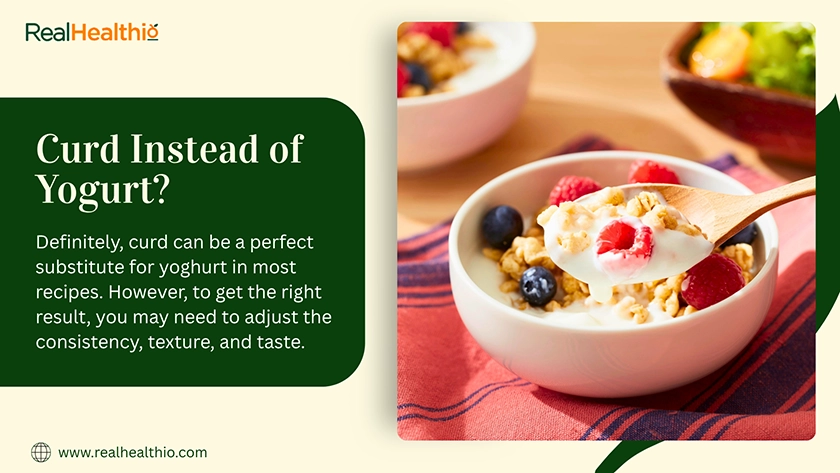
Yes, curd can be a perfect substitute for yoghurt in most recipes. However, to get the right result, you may need to adjust the consistency, texture, and taste.
Here’s what you need to do if you are wondering, can we use curd instead of yogurt :
- Adjust the consistency because curd is thinner and yogurt is thicker. Strain through the muslin cloth to adjust it.
- Check the taste, as curd can sometimes be more sour than commercially prepared yogurt. Adjust the taste by adding sugar.
- For smoothies, both curd and yogurt work well. However, use plain curd or yogurt for a creamy texture.
- Marinades, dips, and sauces require a smooth texture. Prepare a thick curd base by straining its whey through a muslin cloth.
- For dessert and baking, it is advised to rely on commercially prepared yogurt with standardized texture, as curd may alter the moisture of the batter.
Bottom Line
Summing up, the main difference between yogurt and curd is their preparation method and bacterial composition. Although yogurt is a better and healthier option, with high protein content and low carbs, making it ideal for diets, weight loss, and management, curd is easily available and can be made at home with simple ingredients.
Both are fermented dairy products and hence can be used interchangeably for cooking and baking with minor adjustments in consistency.
Frequently Asked Questions (FAQs)
What is the main difference between yogurt and curd?
Are yogurt and curd the same?
No, curd and yogurt are not the same. They differ in terms of their preparation method, taste, texture, bacterial composition, shelf life, culinary uses, nutritional values, and lactose content.
Are Greek yogurt and curd the same?
No, Greek yogurt and curd are not the same. They have different preparation methods, bacterial composition, taste, and texture.
Which is better, yogurt or curd?
Yoghurt is a suitable option for mildly lactose-intolerant individuals, people on diets, and for weight loss. It is protein-dense and supports overall gut health. Curd is affordable, easily available, and an ideal part of everyday Indian meals.
Can we use curd instead of yogurt?
Yes, curd can be used instead of yogurt in all the major recipes; however, it requires adjusting consistency, texture, and taste, as the recipe demands.
Do yogurt and curd taste the same?
No, both yogurt and curd have quite distinctive tastes. While curd is soft and lumpy and ranges from mildly tangy to sour, depending on the fermentation period, yogurt tastes more tart, with a thick and creamy texture. However, store-bought yogurts have added sugars and flavours, which may change their tanginess.
Which is better for weight loss, yoghurt or curd?
Yoghurt is better for weight loss because it contains more protein and probiotics, which can help speed weight loss, than curd. Curd, although prepared naturally, has less protein and fewer probiotics required for weight loss.
Latest Blog



Related Posts